Article
Developing and improving designers
A mistake people make when developing designers is judging progress by what they deliver.
The problems, products and business priorities they're working on can change every few months, so the output alone doesn't tell you whether someone is becoming a better designer.
So how do you judge improvement?
Is it the quality of their work, and how do you objectively critique that? Is it how quickly they get there? How much direction they need? How well they explain and defend their decisions? How effectively they work with product and engineering? Or the impact their work ultimately has?
None of those things on their own tells you whether someone is becoming a better designer.
I remember being a junior designer and having a Head of Design sit next to me after I'd finished something. He'd show me how a few small changes, or sometimes a complete rethink, could make the work better.
I could see what better meant
Years later, when I took graduates under my wing at Auto Trader, I realised how important that clarity was. At that stage of your career, even a basic list of expectations helps you understand where you are, what the next level looks like and what you need to improve.
As designers become more experienced, that becomes harder to define
There can also be cynicism around performance reviews and personal development plans. Too often they're aligned to what the business needs someone to deliver that year, rather than how that person needs to develop as a designer.
Hard skills and soft skills
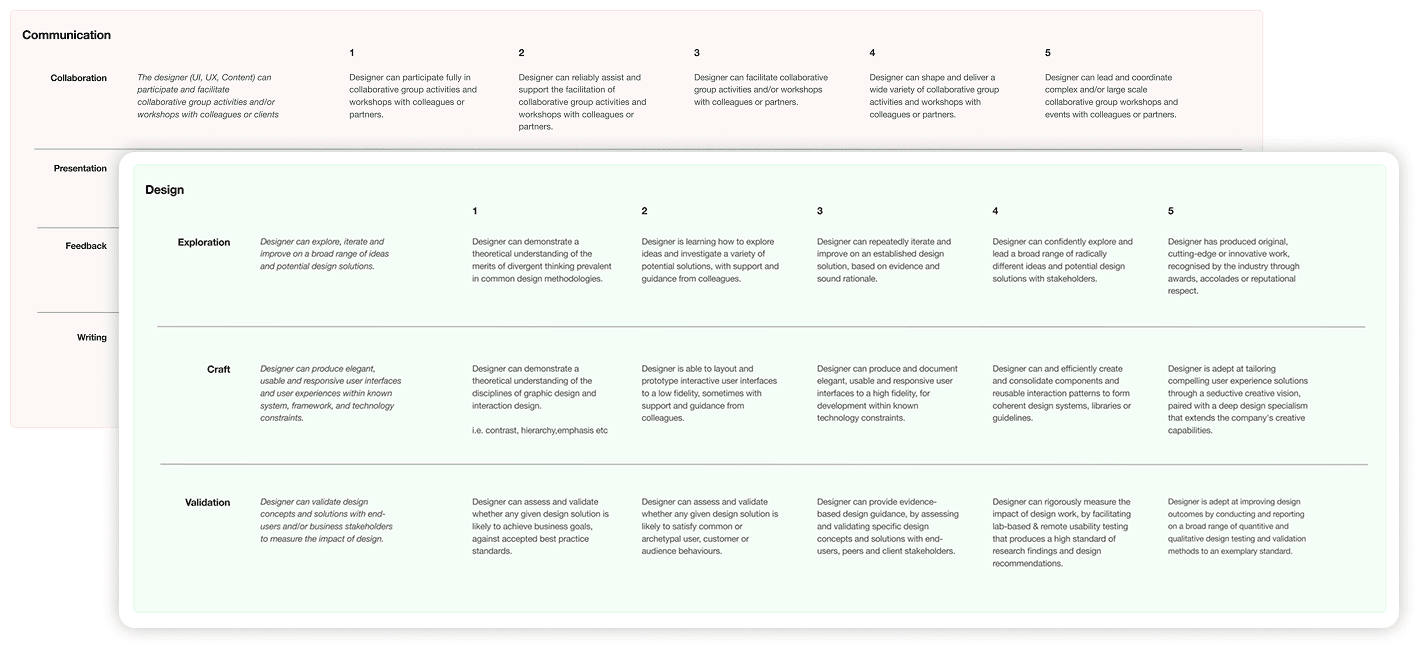
I introduced a job architecture framework that looked at both the hard design skills and the softer skills that make designers effective.
Exploration, problem solving, research, craft and methodology mattered. But so did initiative, communication, collaboration, planning and the ability to bring other people with you.
It gave designers and their managers a shared language for discussing development.
Where am I now? What does the next level look like? Where am I strong? Where do I need help?
It also meant development could continue even when the work changed. A project might disappear, a roadmap might change or a business priority might move, but the skills someone was developing remained relevant.
Managing, coaching and mentoring
A framework alone doesn't develop anyone.
Sometimes someone needs managing: clear expectations, standards, feedback and accountability.
Sometimes they need coaching: helping them work through a problem and reach the answer themselves.
Sometimes they need mentoring: sharing your own experience and showing them how you might approach something differently.
And sometimes they need the space and trust to make the decision themselves.
Knowing which approach someone needs, and when, is an important part of leading and developing a design team.
Learning from each other
I also wanted development to happen outside one-to-ones and annual reviews.
Across teams in the UK, Poland and India, I created regular opportunities for designers to share work, critique each other and learn together. I also launched a Designers' Guild to connect internal and external teams across different locations and levels of experience.
This gave people more ways to learn than simply receiving feedback from their manager.
The aim was to develop designers who could make better decisions, explain those decisions, collaborate effectively and consistently produce high-quality work.
For me, that's a much more useful way of judging whether someone is improving as a designer.